
The Drover’s Wife
As a newly prescribed text for the 2027–2028 HSC Common Module, Henry Lawson’s short fiction speaks to an easily overlooked detail in the syllabus. Tucked within the Understanding section is a prompt to examine how texts shape “personal and public worlds” – and Lawson’s stories provide an ideal lens through which to explore the friction between them.
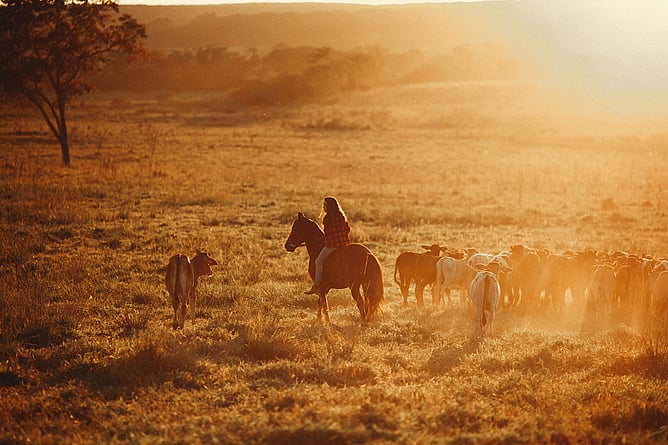
An initial reading of The Drover’s Wife might focus on Lawson’s realist portrayal of outback hardship, depicted through a mother’s solitary defence of her home and children against bushfires, floods, rogue swagsmen, and deadly wildlife. Through this portrayal, Lawson illuminates the disparity between the romanticised public mythology of pioneering life, which celebrates the grandeur of the Australian landscape and idealises frontier existence, and the domestic hardships endured by those whose labour helps sustain it.
However, Lawson also incorporates elements of Australian Bush Gothicism into his realist narrative. Traditional Gothicism frequently employs decaying architecture and oppressive interiors to establish an atmosphere of dread and psychological confinement. Lawson relocates these conventions to the Australian bush, transforming the seemingly boundless landscape into an environment of perpetual isolation. Its monotony, stillness, and remoteness replace conventional Gothic architecture, producing a paradox in which the very landscape publicly associated with freedom and opportunity becomes a source of private entrapment.
For example:
This inversion is established in the opening description of the setting, “Bush all around – bush with no horizon, for the country is flat”. The repetition of “bush”, coupled with the absolute diction in “no horizon”, deprives readers of a discernible vanishing point, flattening the seemingly expansive terrain into an enclosing expanse of vegetation. With no discernible boundary between the homestead and the surrounding wilderness, the mother’s isolation becomes more than a consequence of physical remoteness, as it is embedded within a landscape that offers neither psychological respite nor the prospect of escape. Lawson thereby complicates romanticised representations of the Australian landscape associated with bush writers such as Banjo Paterson and Will Ogilvie, and Heidelberg School painters such as Arthur Streeton and Tom Roberts, whose works helped popularise cultural ideals that frequently privileged the grandeur of frontier existence over the domestic hardships underpinning it.
* Please note that while this information is a great starting point for these texts, relying solely on the information in this post will not be enough to get a result in the top bands.